
In warehouse system design, selecting the appropriate pallet racking configuration directly impacts storage density, picking efficiency, and long-term ROI. Among the most widely deployed systems are Selective Pallet Racking and Drive-in Racking.
This guide provides a structured comparison of both systems—covering accessibility, storage density, cost structure, SKU strategy, and operational fit—so you can determine which solution aligns with your facility’s throughput and inventory profile.
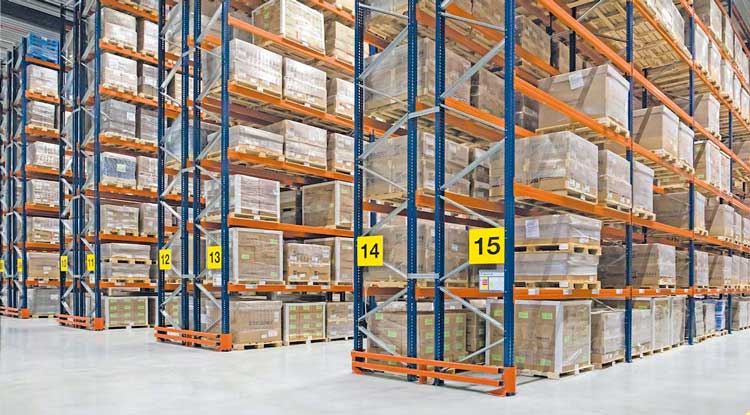
What Is Selective Pallet Racking?
Selective Pallet Racking is the most common warehouse storage system. It consists of upright frames and horizontal beams that create individual pallet positions accessible directly from the aisle.
Key Characteristics
- 100% direct access to each pallet
- Compatible with standard forklifts
- Adjustable beam levels
- Ideal for varied SKU inventory
Advantages
✔ High selectivity (no pallet relocation required)
✔ Flexible layout and easy reconfiguration
✔ Lower initial investment compared to high-density systems
✔ Suitable for FIFO (First-In, First-Out) inventory management
Limitations
✖ Lower storage density (more aisle space required)
✖ Not optimal for large volumes of identical SKUs
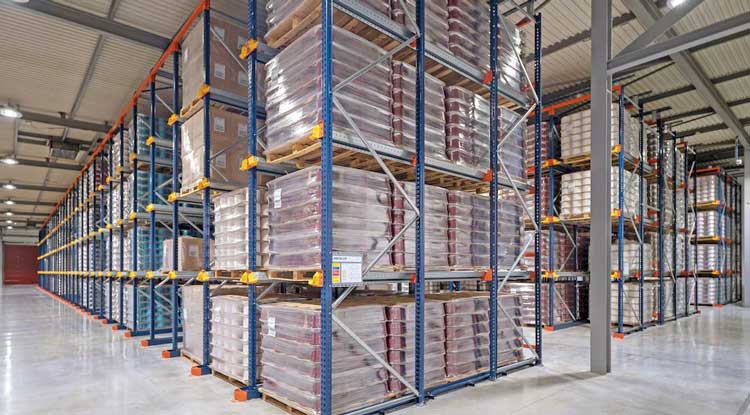
What Is Drive-in Racking?
Drive-in Racking is a high-density storage system where forklifts enter the rack structure to place pallets on rails. Pallets are stored several positions deep, eliminating multiple aisles.
Key Characteristics
- High-density block storage
- LIFO (Last-In, First-Out) principle
- Fewer aisles, more pallet positions per square meter
Advantages
✔ Maximizes cubic warehouse space
✔ Ideal for bulk storage of homogeneous SKUs
✔ Lower cost per pallet position
✔ Particularly effective in cold storage environments
Limitations
✖ Limited selectivity
✖ Slower picking compared to selective systems
✖ Higher structural impact risk (forklifts operate inside lanes)
When Should You Choose Selective Pallet Racking?
Choose selective racking if:
- You manage many SKUs with lower quantities per SKU
- Fast order picking is critical
- Inventory rotation requires FIFO
- You need layout flexibility for future expansion
- Your warehouse has sufficient floor area
Typical industries: e-commerce fulfillment centers, retail distribution, spare parts warehouses.
When Should You Choose Drive-in Racking?
Choose drive-in racking if:
- You store large quantities of identical products
- Storage density is more important than selectivity
- You operate cold storage or limited floor space
- Inventory rotation follows LIFO
- Labor cost per pallet needs to be minimized
Typical industries: food & beverage, cold chain logistics, beverage distribution, manufacturing bulk storage.
Cost Considerations
While Drive-in racking typically has:
- Higher structural steel requirement per lane
- Lower aisle construction cost
- Lower cost per pallet position overall
- Selective racking often provides:
- Lower installation complexity
- Reduced repair and maintenance costs
- Greater operational efficiency
The optimal choice depends on space cost vs. operational efficiency trade-offs.
Hybrid Strategy: Combining Both Systems
Many modern warehouses integrate both systems:
- Selective racking for high-turnover SKUs
- Drive-in racking for bulk reserve storage
This dual-zone strategy maximizes both accessibility and density while optimizing picking efficiency.
Final Decision Framework
Ask the following questions:
1. How many SKUs do I manage?
2. What is the average pallet quantity per SKU?
3. Is FIFO mandatory?
4. What is my warehouse space cost per square meter?
5. Is picking speed or storage density my top priority?
If selectivity and speed matter most → Choose Selective.
If space utilization and bulk storage dominate → Choose Drive-in.
Conclusion
Both Selective Pallet Racking and Drive-in Racking serve critical roles in warehouse design. The decision should be data-driven—based on SKU profile, throughput, facility constraints, and long-term growth strategy.
Careful evaluation at the planning stage ensures your storage system supports operational efficiency rather than becoming a constraint.
Post time: Feb-10-2026